
OmarGhattas
- omar@ices.utexas.edu
- 512-232-4304
- POB 4.236A
Computational fluid, solid, bio and geomechanics; Inverse problems and optimization; Uncertainty quantification; Parallel numerical algorithms and large-scale supercomputing
About
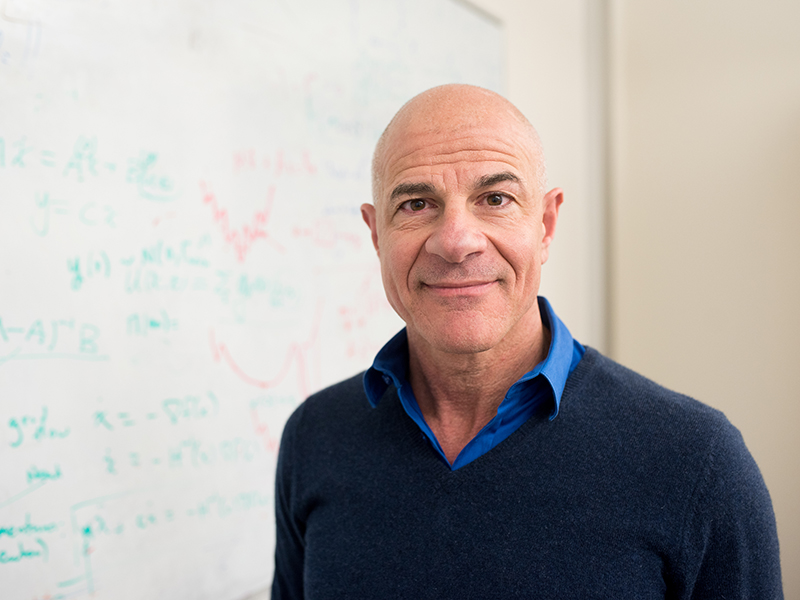
Omar Ghattas is Professor of Mechanical Engineering at The University of Texas at Austin and holds the Cockrell Chair in Engineering. He is also Principal Faculty in the Oden Institute for Computational Engineering & Sciences and Director of the OPTIMUS (OPTimization, Inverse problems, Machine learning, and Uncertainty for complex Systems) Center. He is a member of the faculty in the Computational Science, Engineering, and Mathematics (CSEM) interdisciplinary PhD program in the Oden Institute, and holds courtesy appointments in Earth & Planetary Sciences, Computer Science, and Biomedical Engineering.
Before moving to UT Austin in 2005, he spent 16 years on the faculty of Carnegie Mellon University. He is a Fellow of the Society for Industrial and Applied Mathematics (SIAM) and of the U.S. Association for Computational Mechanics (USACM). He serves on the National Academies Committee on Applied and Theoretical Statistics, is director of the M2dt Center (a DOE ASCR-funded multi-institutional collaboration developing the mathematical foundations for digital twins), and serves as Co-PI and Chief Scientist for TACC’s Frontera and Horizon HPC system.
Ghattas’s research focuses on advanced mathematical, computational, and statistical theory and algorithms for large-scale inverse and optimal design/control problems governed by models of complex engineered and natural systems. He and his group are developing algorithms to overcome the challenges of Bayesian inverse problems and data assimilation, Bayesian optimal experimental design, and optimal control & design under uncertainty, for large-scale complex systems. These include structure-exploiting methods for dimension reduction, surrogates, and neural network approximation, along with high performance computing algorithms. These components are integrated and coupled together to form frameworks for digital twins.
Driving applications include those in geophysics and earth systems (earthquakes, ice sheet dynamics, ice-ocean interaction, poroelasticity, seismology, subsurface flows, tsunamis), advanced materials and manufacturing processes (metamaterials, nanomaterials, additive manufacturing, nondestructive evaluation), and complex fluids.
Educational Qualifications
- Ph.D. Computational Mechanics, Duke University, 1988
- M.S. Computational Mechanics, Duke University, 1986
- B.S., Civil and Environmental Engineering, Duke University, 1984
Select Awards & Honors
- ACM Gordon Bell Prize (2003, 2015, 2025)
- SIAM Ivo and Renata Babŭska Prize (2025)
- SIAM Computational Science & Engineering Best Paper Prize (2019)
- SIAM Geosciences Career Prize (2019)
- ACM Gordon Bell Prize Finalist (2008, 2010, 2012)