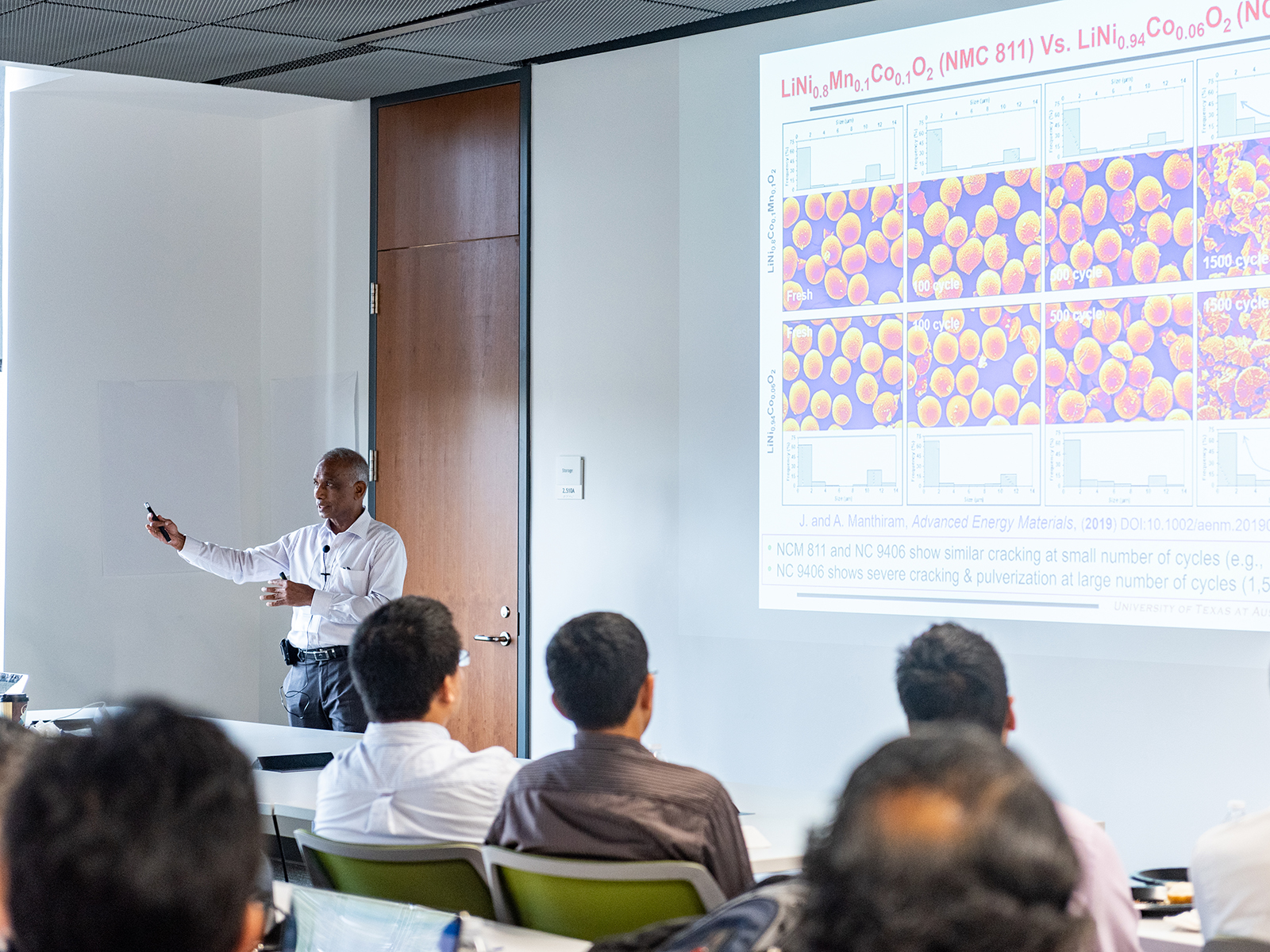
Named after Distinguished Alum Byron Short, this series brings leading experts to the Walker Department of Mechanical Engineering to share insights on emerging research, technologies and innovations. Lunch is provided to attendees.
FREE
ETC 2.136
About the Speaker
Faez Ahmed is an Associate Professor in the Department of Mechanical Engineering at MIT, where he directs the Design Computation and Digital Engineering Lab. His research lies at the intersection of artificial intelligence and engineering design, focusing on first-principles generative AI, optimization algorithms, multimodal learning, and human–AI design co-pilots. Before joining MIT, Prof. Ahmed was a postdoctoral fellow at Northwestern University and earned his Ph.D. in Mechanical Engineering from the University of Maryland. He also spent several years in Australia’s railway and mining sector, leading data-driven predictive maintenance initiatives. Prof. Ahmed has received several honors, including the NSF CAREER Award, the AFOSR YIP Award, the Google Research Scholar Award, and the Keenan Award for Innovation in Undergraduate Education. His work aims to redefine how engineers design and innovate through AI-driven tools and human–AI collaboration.
Abstract
Generative AI is transforming how we create, customize, and accelerate digital content. Yet applying these tools to engineering design introduces unique challenges, from maintaining precision under evolving requirements to working effectively in data-scarce environments and interpreting designer intent. In this talk, I will discuss these challenges and show how emerging engineering-native AI models are beginning to address them, reshaping workflows in areas such as vehicle design, CAD automation, and design optimization. I will highlight new opportunities enabled by generative AI that integrates multimodal data with engineering simulations and optimization, and present examples of AI-driven design co-pilots for engineering tasks. The talk will conclude with a perspective on how AI enables us to broaden design democratization, accelerate innovation cycles, and fundamentally reshape the role of engineers.